
Taking Stock on Climate Stocktakes
Dr Rory Sullivan and Chup Priovashini
Having a climate policy is one thing, but how well is that policy being implemented and is it continuing to meet the investor’s objectives? One way to answer these questions is through a climate stocktake – a process to analyse how climate policy ambitions match reality. Chronos conducted comprehensive stocktakes of Brunel Pension Partnership’s Climate Policy in 2022 and 2025. This article provides an overview of the stocktake process and reflects on the lessons learned.
Background
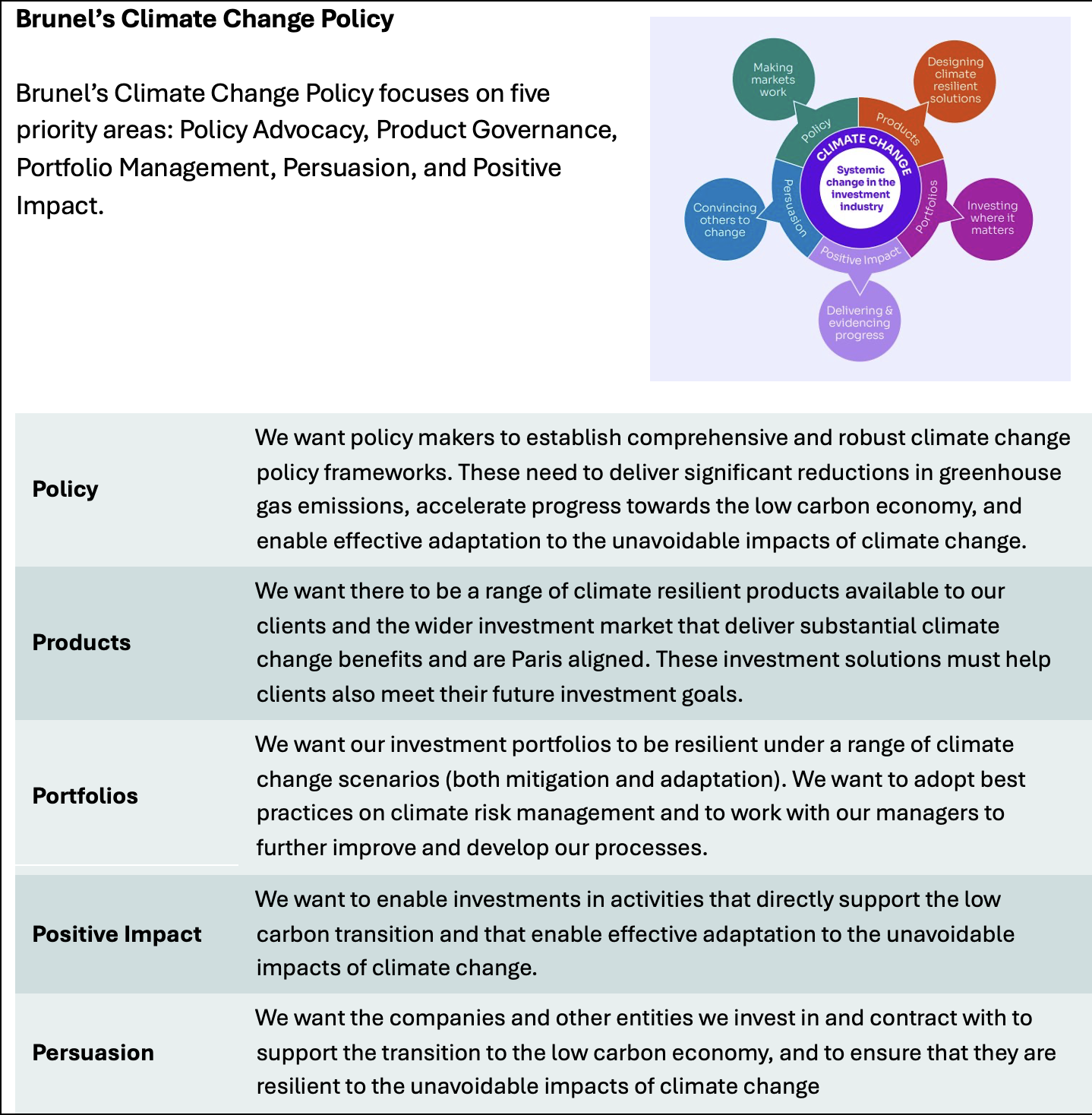
In 2020 Brunel Pension Partnership, one of eight UK Local Government Pension Scheme (LGPS) pools, published its first Climate Change Policy with a commitment “to systematically change the investment industry to ensure that it is fit for purpose for a world where the temperature rise needs to be kept to well below 2°C compared to pre-industrial levels.” The 2020 policy included a commitment to conduct a climate stocktake in 2022 to assess progress on implementation. In 2023 Brunel published an updated Climate Change Policy 2023-30 incorporating findings from its 2022 stocktake. The updated policy included a commitment to repeating the stocktake exercise in 2025 to ensure that Brunel’s approach remained fit for purpose and continued to reflect client needs.
The Stocktake Process
The objectives of the stocktakes we undertook in 2022 and 2025 were to assess:
Whether Brunel had delivered on the objectives and targets it had set for itself,
The outcomes (financial, mitigation, adaptation) that had been achieved, and
Whether the policy met client and beneficiary expectations and needs.
In turn, the stocktake process aimed to inform changes/modifications to Brunel’s climate-related objectives and targets and, as needed, changes to the Climate Policy.
The stocktake review processes involved:
Interviews with the Brunel management, investment and responsible investment teams.
Detailed reviews of Brunel materials and reports including its public climate change and stewardship reports, its policies, and a wide range of performance (climate and financial) monitoring reports.
Workshops with client pension funds and reviews of climate surveys.
Structured interviews with client pension funds (and, in 2022, with selected external stakeholders) to gauge their views on Brunel’s approach to climate change.
Target-by-target review to determine the actions taken, the outcomes achieved, the extent to which these outcomes could be attributed to the actions taken, and whether these outcomes met the specified actions and targets. Our assessments needed to account for the fact that the completion data for many targets was longer-term (e.g. to 2030). Therefore, the stocktake needed to assess progress to date against the target as well as whether the activities being conducted were setting up that target to be successful.
Presentation of the initial and final findings/conclusions to the Brunel management, investment and responsible investment teams.
Five Reflections
Stocktakes provide an opportunity to reflect on (a) the historic evolution of performance, (b) the future evolution of performance, and (c) the factors that have driven and will drive performance. In the case of Brunel, the trend analysis produced for the stocktakes allowed it not only to assess progress at a point in time but also, importantly, to identify where progress was accelerating or stalling, and reflect on the reasons why.
Stocktakes can support mature, well-informed discussions between investors and their stakeholders.
The commitment to conduct a stocktake can allow investors to set ambitious climate change goals, knowing that there is a process for reviewing the outcomes that have been achieved. In Brunel’s case, both when establishing the policy in 2020 and revising the policy in 2023, member funds were concerned about the implications for investment performance. The stocktake commitment reassured the member funds that Brunel had a formal process in place to review its performance in both climate and investment terms and that Brunel would be willing to adjust its strategy if needed.
Stocktakes can play a valuable role in building trust and confidence. The involvement of clients in the stocktake process (e.g. in setting objectives, in reviewing the findings) allowed Brunel to demonstrate its receptivity and responsiveness to clients’ concerns. For example, the greater emphasis on adaptation and physical climate risk in Brunel’s 2023 to 2030 climate policy was a direct response to a priority need identified by many of its member funds. Another interesting reflection from the Brunel stocktake was that, through the engagement with member funds and other stakeholders, Brunel discovered how highly it is regarded by the investment community. For example, many stakeholders commended Brunel for its transparency and accountability, and for the ambition that underpinned its approach to climate change.
Stocktakes allow organisations to strengthen/refine their approach. For example, in the first stocktake, member funds pointed to (industry-wide) gaps in data and methodologies as limiting their ability to fully assess and understand Brunel’s performance. As a result, Brunel committed to strengthening its data analysis and reporting.
According to the PRI over 80% of its signatories have a policy or process in place to recognise climate-related financial risks and opportunities. In a rapidly changing world, a climate stocktake can help investment organisations to understand what elements of their policy are working and are not working, can enable investment organisations to engage stakeholders on their climate and investment activities, and can provide a robust basis for ensuring that policy remains fit for purpose in a rapidly changing world.
Notes:
1. To read more about Burnel Pension Partnership’s climate stocktakes, see:
• Climate Change Progress Report 2025: https://www.brunelpensionpartnership.org/2026/05/28/2025-report-shows-major-progress-across-brunel-portfolios-on-emissions-and-reserves-exposure/
• Climate Stocktake 2022: https://www.brunelpensionpartnership.org/investing-responsibly/responsible-investment/climate-change/#climate-stocktake
• Faith Ward MBE’s comment on the stocktake process for IPE Magazine: https://www.ipe.com/comment/viewpoint-progress-managing-climate-risk-means-stops-as-well-as-sprints/10065145.article
To talk with Chronos about climate stocktakes or any of our climate-related work click here or contact: rory@chronossustainability.com
