
Five years of the CCLA Corporate Mental Health Benchmark - what does the data show?
Nicky Amos and Chup Priovashini
The 2026 CCLA Corporate Mental Health Benchmark UK 100 Report, published last week, marks five years since the benchmark was launched in 2022. This milestone provides an opportunity to look beyond this year’s results and examine how corporate management of workplace mental health has evolved over time – and where important gaps remain.
1. Progress has been steady
Over the past five years, workplace mental health has become increasingly embedded in corporate governance and management practices across the UK’s largest listed companies.
Key findings include:
The average benchmark score across all 100 companies increased from 35% in 2022 to 47% in 2026, representing a 12-percentage point increase.
Among the 81 assessed every year since the benchmark began, average performance rose from 36% to 49% over the same period.
The number of companies achieving the highest ranking, Tier 1, rose from just three in 2022 to 13 in 2026.
Almost all companies (99%) now recognise workplace mental health as a business issue and provide some form of mental health support. Meanwhile, 82% publish a formal mental health policy or equivalent, demonstrating that governance expectations are becoming established.
Engagement with the benchmark has also grown, with 82% of companies participating in the benchmarking process, up from 77% in 2025.
Taken together, these findings suggest that workplace mental health is no longer viewed as a peripheral wellbeing issue, but increasingly as a material business consideration requiring formal oversight.
2. Progress is becoming harder to achieve
Despite these gains, the pace of improvement has slowed.
The increase in average benchmark performance between 2025 and 2026 was just one percentage point (46% to 47%), making it one of the smallest year-on-year improvements since the benchmark began.
The data also show that while governance and policy frameworks continue to strengthen, companies are finding it more difficult to demonstrate effective implementation and impact.
For example:
Although most companies now publish a mental health policy, only around half include a comprehensive explanation of how their policies are implemented in practice.
Mental health support and awareness initiatives are now almost universal, yet fewer than half of companies disclose information on employee uptake and outcome initiatives, making it difficult to assess whether these initiatives are reaching the workforce. Only 23% of companies disclose the key performance indicators they use to measure the effectiveness of their approach.
Only 56% of companies report providing mental health training for line managers, despite the critical role managers play in shaping employees’ day-to-day workplace experience and supporting early intervention.
These findings suggest that many companies have established the necessary structures, but fewer are demonstrating that these arrangements are being translated into consistent practice.
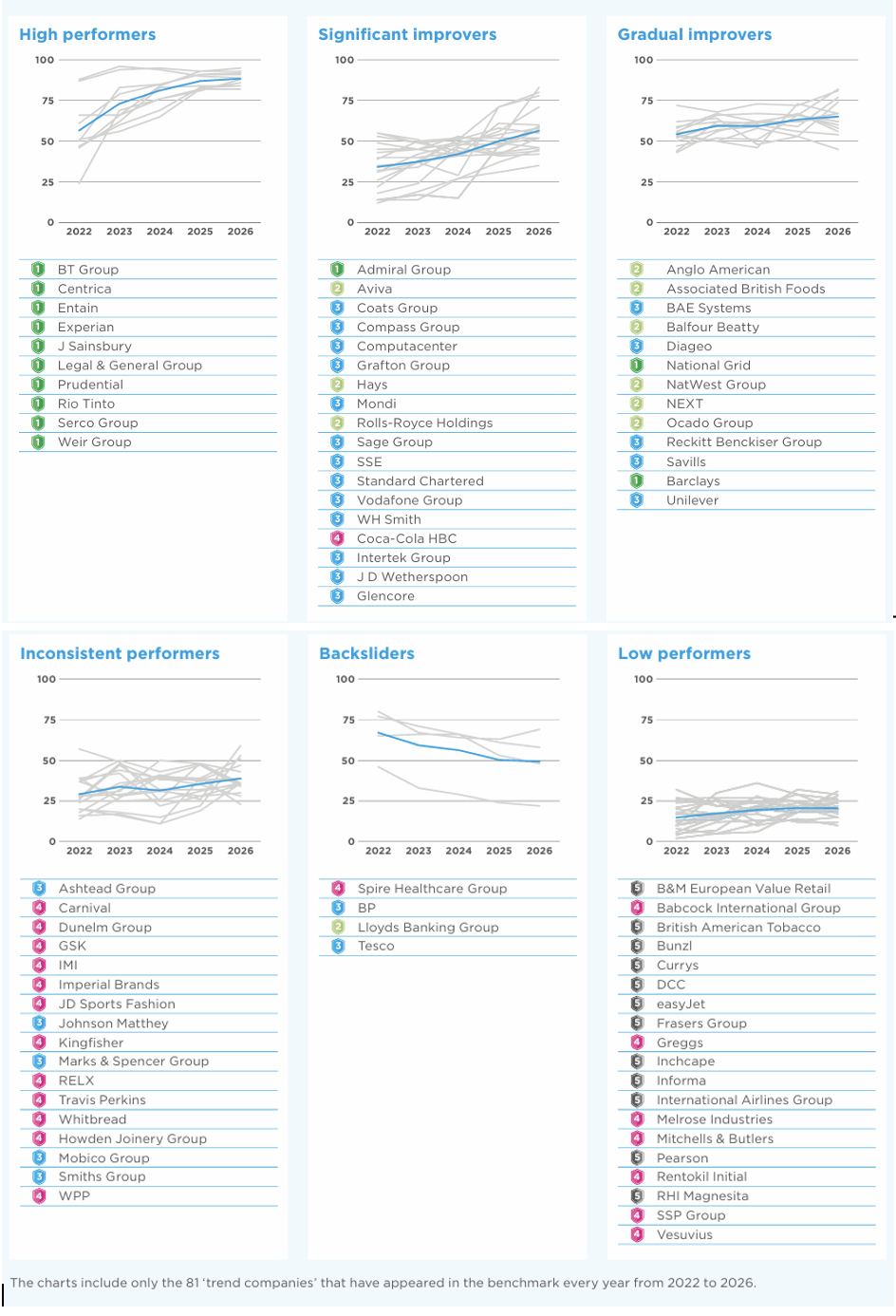
Image: the six distinct improvement trajectories identified in our analysis
3. Not all companies are progressing at the same pace
Looking across five years of data also reveals a widening divergence in company performance.
Our analysis identified six distinct improvement trajectories over the life of the benchmark. While many companies have steadily strengthened their approach to workplace mental health, the largest group consists of companies that have shown limited or no improvement in scoring over five years.
This divergence is masked by improvements in the overall average score. Some companies continue to make substantial progress, while others appear to have plateaued.
How can companies make further progress?
Companies must now shift their focus beyond policy commitments, to set measurable objectives on workplace mental health and publish data on programme uptake and effectiveness. The criteria that drove early gains are now close to their ceiling - recognising mental health as a business issue, publishing a policy and offering basic support services are now met by 82–99% of companies. In contrast, Performance Reporting and Impact remains the lowest-scoring pillar after five years.
As workplace mental health continues to mature as an ESG issue, investors and other stakeholders will increasingly expect companies to demonstrate not only that appropriate governance, policies and processes are in place, but also that these are delivering measurable improvements in employee mental health and wellbeing.
Independent benchmarks are a powerful driver of workplace mental health progress, corporate transparency and accountability. By offering robust, consistent and comparable assessments of company practices, they help investors and other stakeholders distinguish genuine progress from policy commitments alone, and track performance over time.
Through its continued leadership on this issue, CCLA is helping to encourage companies to move beyond governance and policy, toward measurable outcomes - supporting more informed stewardship and investment decisions, and holding companies to account for translating commitment into impact.
Visit the CCLA website for further information.
Chronos Sustainability is technical partner to CCLA on the Corporate Mental Health Benchmark. Our role includes developing the assessment framework, conducting company research, and analysing and reporting the benchmark results.
