
From Ambition to Action: How Investors Are Using Transition Plans
Rory Sullivan, Robert Black and Cora Buentjen
Transition plans are strategic, forward-looking documents that set out how firms will respond and contribute to the transition to a low-emissions and climate resilient economy. Transition planning allows companies (and other organisations) to strategically consider the impact of a low carbon economy on their business models, demonstrate how the business will manage the risks and opportunities associated with the low carbon transition, and explain how capital and operating expenditures will be affected by the low carbon transition. Transition plans also allow companies to discuss how their strategies depend on the actions of others (e.g. regulatory requirements, policy incentives, customer and consumer demand). Transition plans can, therefore, be used to inform investment and policy decision-making.
What is a transition plan?
The IFRS S2 Standard defines a climate-related transition plan as follows:
“A climate-related transition plan is an aspect of an entity’s overall strategy that lays out the entity’s targets, actions, or resources for its transition towards a lower-carbon economy, including actions such as reducing its greenhouse gas emissions.”
Transition planning and transition plans are still a relatively new concept. Since 2022, following the work of the UK Transition Plan Taskforce, a series of transition planning frameworks and guidance notes have been published and an increasing number of companies have published transition plans or similar documents.
Investors support for transition plans is rising. For example, a recent South Pole survey found that 77% of 350 financial institutions globally consider portfolio companies more attractive if they have a climate transition plan. Yet limited empirical evidence exists on how investors actually use these disclosures in practice.
Chronos Sustainability was commissioned by the International Transition Plan Network (ITPN) to address this knowledge gap. Using a survey and interviews with 35 global institutional investors and five data providers, we analysed how investors are currently using transition plans to shape investment decisions, inform their stewardship and support the development of investment products.
What We Found
Twenty-nine of the 35 investors covered by the research reported using transition plan information in their investment and/or stewardship processes. Use is most widespread in stewardship, where over 75% of these 35 investors reported that they use transition plan information to prioritise engagement, structure dialogue with companies, or inform voting decisions. Furthermore, approximately half integrate this information in their portfolio monitoring and risk management, while over a third incorporate it into fundamental analysis. Use in passive investment and labelled product design remains limited, with a number of those interviewed pointing to the need for broader coverage across sectors and jurisdictions, more decision-useful disclosure (particularly around financial metrics), and greater standardisation to enhance comparability.
One of the most striking findings – given how many leading investors have made net zero or similar commitments - was that the participating investors prioritise ‘financial credibility’ over climate-related outcomes. As one European asset manager put it: "In our investment analysis, we are less worried about whether it is sufficient for net zero and more about whether it is [financially] credible."
This emphasis on financial credibility has led investors to focus attention on (a) governance, (b) implementation strategies, (c) financial metrics such as capital expenditure, and (d) key assumptions and dependencies. Interviewees commented that these are the elements that allow investors to assess whether companies can realistically deliver on their commitments.
The report provides six actions that companies, investors, data providers, policymakers, and regulators can consider to achieve the full potential of transition plans as a tool to support investment decision-making:
1. Companies should strive to develop credible transition plans, disclosing essential elements requested by investors, such as clear implementation plans that are actionable and timebound, with financial information and key assumptions.
2. Investors should engage with a wide range of stakeholders (including investee companies, policymakers, investor peers, data providers, and asset managers) to promote credible disclosures of transition plans.
3. ESG data and ratings providers, credit rating agencies, ESG benchmark providers, and index providers should support the development and scaling of data products based on transition plan information.
4. Governments and regulators should consider requirements to promote the widespread and standardised disclosure of credible transition plans, including mandatory disclosure.
5. Policymakers should consider publishing sector transition plans (STPs) to enable investors and data providers to evaluate company transition plans in the context of national transition strategies.
6. Policymakers should consider using transition plan information to design effective policy interventions that reduce misalignment between climate and industrial policy, and accelerate the transition to a low-emissions, climate-resilient economy.
Our Reflections
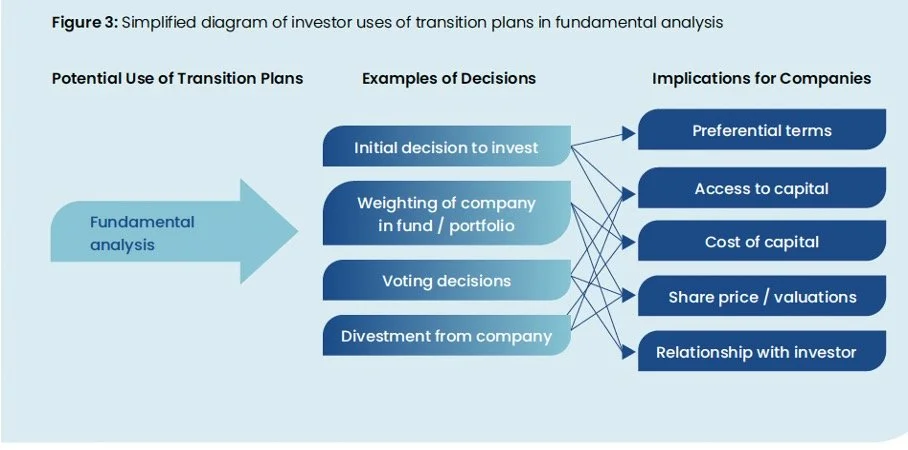
Our research shows the use of transition plans in investment decision making is evolving quickly (see Figure 3 from the report below). Most notably, transition planning appears to be shifting from a focus on ambition, to a focus on action.
This mirrors the experience in initiatives such as CA100+ where the initial focus was on high level commitments, and then moved to short- and medium-term targets and the actions that underpin those targets. Our research suggests that investors are increasingly focused on how the transition is occurring in practice, and on which companies have credible plans to decarbonise and enable the transition. Transition planning itself reflects this maturing, challenging companies to move beyond setting targets and focus on developing and delivering robust implementation plans.
Our research suggests that work is needed if transition planning is to be more fully integrated in investment decision-making. Policymakers should promote widespread and standardised disclosure of credible transition plans, alongside supportive policy frameworks that support necessary technological developments and industrial transformation. Investors themselves should further integrate transition plan information into investment research and decision-making, while sharing emerging good practice across the market.
Demonstrating that credible transition plans carry real financial consequences is an essential market signal if transition planning is to support policy goals such as emissions reductions, competitiveness and financial stability.
--
Notes
1. The report, Enhancing Long-Term Value and Resilience: A Study of How Global Investors are Using Transition Plans, is available at: https://itpn.global/wp-content/uploads/2026/05/ITPN-Enhancing-Long-Term-Value-and-Resilience-May-2026.pdf.
2. The International Transition Plan Network (ITPN) was launched at COP29 to support the development of global norms for private sector climate transition plans and drive climate policies that leverage the full potential of these plans.
3. Chronos Sustainability led the drafting of the UK Transition Plan Taskforce’s Electric Utilities & Power Generators Sector Guidance.
--
Read more about our work on climate, net zero and transition planning here or get in touch with: rory@chronossustainability.com
