
At Chronos Sustainability, we have been exploring nature’s intersection with health. This has opened up a more human and outcome-oriented perspective on nature-related risk.
How Health can help unify nature and climate in sustainable finance
Health may become a lead framing for sustainable finance because it ties together climate, nature, labour, inequality and economic resilience through tangible human outcomes that people immediately recognise. It moves us from abstract sustainability themes to more tangible, human outcomes.
Health is increasingly functioning as the connective framework through which environmental and social risks are experienced in the real economy. It provides investors with a more integrated lens for assessing systemic risk, and one that connects environmental and social exposures to financial consequences. These include:
Transition risks – for example as regulation tightens around high-emitting polluters and as courts increasingly link pollution-related harms to human rights and corporate liability;
Supply chain disruption – for example where ecosystem degradation undermines resource availability and disrupts logistics); and
Reduced workforce productivity – for example from exposure to air pollution or heat stress.
Environmental health risks can translate into significant financial exposures across sectors:
Water pollution is creating major legal and regulatory exposure: PFAS pollution led to a USD 1.185 bn settlement involving DuPont, Chemours and Corteva, while 3M’s US liability could reach USD 25 bn. For Freeport-McMoRan, one of the world's largest mining companies, pollution-related regulatory tightening contributed to an 18% share price fall, delayed a ~USD 3.85 bn divestment, and exposed it to ~USD 12.95 bn in potential damages.[1]
Air pollution is eroding productivity and increasing liability: The OECD estimates 1.2 billion workdays are lost annually to ambient air pollution, rising to 3.8 billion by 2060.[2] Urban-exposed sectors such as logistics, construction and retail face higher absenteeism, lower output and growing litigation risk. Volkswagen’s Dieselgate scandal cost over USD 30 bn.[3]
Climate breakdown is raising insurance, credit and valuation risks: Extreme heat is already reducing cognitive and physical performance, and these impacts are beginning to feed through into insurance costs, sovereign risk assessments and real asset values.[4],[5],[6]
Ecosystem degradation is disrupting operations and undermining energy and food supply: Blumar lost nearly USD 10 mn in early 2024 from a single harmful algal bloom,[7] while ground-level ozone could reduce northern hemisphere wheat yields by 8% by 2050.[8] Invasive species caused an estimated USD 1.738 tn in cumulative losses between 1970 and 2020, including impacts on food productivity and disrupting operations of electrical utilities.[9]
Water scarcity is disrupting operations and materially increasing costs: Water scarcity is disrupting operations and increasing costs: Water shortages in Mexico caused a USD 650–680 mn impairment for Constellation Brands’ brewery project.[10] In Chilean copper mining, desalination requirements are increasing capex and opex, with analysis suggesting Net Debt/EBITDA ratios could rise by an average of 80% for mining companies if water usage costs are fully internalised.[11]
Crucially, health also appears to be a less politically contested issue than, for example, climate change or ESG. Unlike many sustainability concepts, health impacts are tangible, measurable and difficult to dismiss ideologically. This gives health the potential to act as a more durable entry point for discussions around environmental and social risk, and is contributing to a notable shift in investor narratives. As The Times recently reported, climate change has been overtaken by human health as the number one priority for responsible investors. Given how closely health links environmental and social issues, this may not represent a retreat from climate change and nature loss so much as a reframing of sustainability around human outcomes and economic resilience.
A systems view of health, nature and climate: Air pollution as a case study
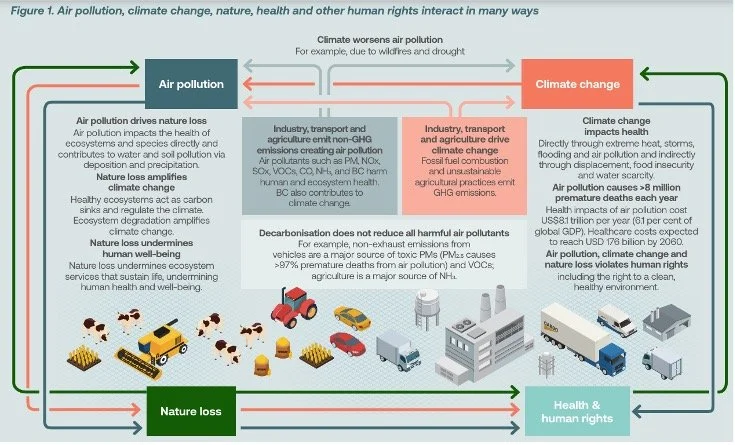
We recently produced an investor briefing on air pollution in partnership with ShareAction. In the briefing, we explained that ambient air pollution is now the largest environmental threat to human health. We also explained that it is closely linked to climate change, nature loss and human rights:
· Air pollutants contribute to global warming, while climate impacts such as wildfires and extreme weather further worsen pollution.
· Air pollution is also a major driver of nature loss, affecting water and soil as well as air.
· This in turn reduces nature’s ability to filter air and store carbon, reinforcing these risks.
These interconnected impacts are already generating significant economic costs. The health impacts of ambient air pollution globally are estimated to cost USD 6 trillion a year (or 4.6% of GDP). The costs of soil degradation alone, due to air pollution deposition, are estimated to be up to $10.7 trillion annually.
The visual we created below[12] illustrates the reinforcing dynamics between air pollution, climate change, nature loss and human health. It highlights why nature loss is increasingly recognised not just as an ecological issue, but as a systemic health risk - and why air pollution is not only a public health crisis, but also a key driver of nature loss that amplifies systemic risk.
Beyond silos: towards an integrated view of risk and resilience
Despite this opportunity, framing health too narrowly could reduce the urgency on climate change and nature loss. Whatever lens is used - whether nature, climate or health – the key is to focus on the interconnections rather than work in silos. The real shift may not be from climate to health, but from thematic ESG categories to an integrated understanding of human and environmental resilience.
This is reshaping our work on nature at Chronos Sustainability, where our team brings together expertise across nature, climate, health, human rights and finance, and where we apply this breadth in our work with clients. Increasingly, we are helping our civil society, investor and corporate clients not only to understand the landscape of nature-related action, but also how nature loss intersects with human rights, climate change and human health. In practice, this means helping companies understand where supply chains depend on nature, how exposures translate into nature – but also health, human rights, and climate impacts - and how is this translates into risk in a rapidly evolving regulatory landscape. Decision-makers who understand the connections between environmental degradation and human health are better positioned to manage risk and opportunity effectively, and protect and create long-term value.
—-
To speak with our team on nature or health issues contact rebecca@chronossustainability.com
Footnotes
[1] BloombergNEF (2023): When the Bee Stings: Counting the Cost of Nature-Related Risks.
[2] OECD (2016) The Economic Consequences of Outdoor Air Pollution.
[3] The Week (2024) The 5 biggest corporate greenwashing fines.
[4] World Economic Forum (2025) Insuring Against Extreme Heat: Navigating Risks in a Warming World 2025 | World Economic Forum
[5] European Central Bank, From words to deeds – incorporating climate risks into sovereign credit ratings (2025).
[6] Allianz (2026) Too hot to grow: The economic costs of extreme heat.
[7] Seafood Source (2024) Algae bloom, facility fire contribute to Blumar’s H1 2024 profits tumbling nearly 85 percent
[8] Economic Commission for Europe. (2022). Report on the review of the Protocol to Abate Acidification, Eutrophication and Ground-level Ozone, as amended in 2012.
[9] IPBES (2023). Thematic Assessment Report on Invasive Alien Species and their Control of the Intergovernmental Science-Policy Platform on Biodiversity and Ecosystem
[10] Constellation Brands (2021) Summary Annual Report
[11] GIZ/NCD/VfU (2015) Integrating water stress into corporate bond credit analysis
[12] ShareAction (2026) Breath of Fresh Air: the risks of air pollution and the opportunities beyond toxic assets.
