
Brunel Pension Partnership, SAI Platform and Chronos team (Gemma James, Laura Fox and Anna Hattam)
As climate impacts become increasingly material to company performance and investor portfolios, Brunel Pension Partnership, supported by Chronos Sustainability, has been engaging with 20 consumer staples companies across the food, beverage and retail sectors. Actively supported by a group of Brunel’s client funds, the engagement programme seeks to strengthen how companies assess and manage climate physical risks, adapt to climate change, and understand how nature-based approaches contribute to build supply chain resilience.
During our engagement, it became clear that many companies are adopting regenerative agriculture to increase the resilience of their supply chains and meet their emissions reduction targets. We have had insightful conversations with the companies about motivation, key objectives and outcomes related to those projects. Many companies referenced the Sustainable Agriculture Initiative (SAI) Platform’ Regenerating Together Programme, with more than half of all companies in the engagement identified as members of SAI Platform.
Founded in 2002 by Danone, Nestlé and Unilever, SAI Platform provides a pre-competitive space for food and beverage companies to collaborate, share learnings, and address common challenges on their journeys to regenerative agriculture. The Regenerating Together Programme (RTP) is a flexible and adaptable toolset that allows farms to work individually or together as implementation groups to develop and implement continuous improvement plans to transition towards regenerative agriculture. By aligning with the RTP, companies can standardise their requirements for farmers (who often face demands from multiple buyers), take advantage of collective scale, and drive meaningful impact across the landscape.
Investors have a role to play
Recognising the need for a joint up approach around regenerative agriculture, the engagement group was keen to learn more about the SAI framework, how companies are using it and some of the challenges they are facing.
We believe investors can play a fundamental role in scaling regenerative agriculture through using their leverage with investee companies by sending clear and reinforcing signals.
By encouraging uptake of frameworks such as SAI Platform’s Regenerating Together Programme amongst investee companies, investors can help to drive greater alignment, clarity and coherence in the expectations being set and communicated across value chains, including retailers. Collaboration across the investment community and the wider industry will be essential to ensure farmers receive clear, consistent signals rather than fragmented or competing demands.
In doing so, investors can help create the enabling conditions to scale regenerative agriculture.
With this in mind, the engagement group invited SAI Platform to deliver an educational session to:
Develop a deeper understanding of regenerative agriculture to better inform dialogues with companies.
Explore how the SAI Platform’s Regenerating Together Platform can support companies in encouraging and enabling downstream suppliers and farmers to transition towards a more regenerative approach.
Support a unified and consistent approach to regenerative agriculture across sectors and throughout supply chains.
Build investor capacity for more consistent and effective engagement on regenerative agriculture, as part of broader climate physical risk stewardship.
The role of regenerative agriculture in building climate resilience
SAI Platform defines regenerative agriculture as “an outcome-based farming approach that protects and improves soil health, biodiversity, climate, and water resources while supporting farming business development [1]”. It encompasses a broad range of practices, including, but not limited to cover cropping, fuel-use efficiency, on-site renewables, integrated nutrient and pest management, protection of on-farm habitat, and integrated grazing management.
Regenerative agriculture can strengthen the resilience of agricultural supply chains by improving soil health, water retention, and biodiversity, helping farming systems withstand multiple climate impacts, such as droughts and floods. By, amongst others, reducing reliance on synthetic inputs and supporting more stable productivity under extreme weather, regenerative agriculture aims to help protect farmer livelihoods and improve yields amid growing climate variability.
Key reflections from the educational session
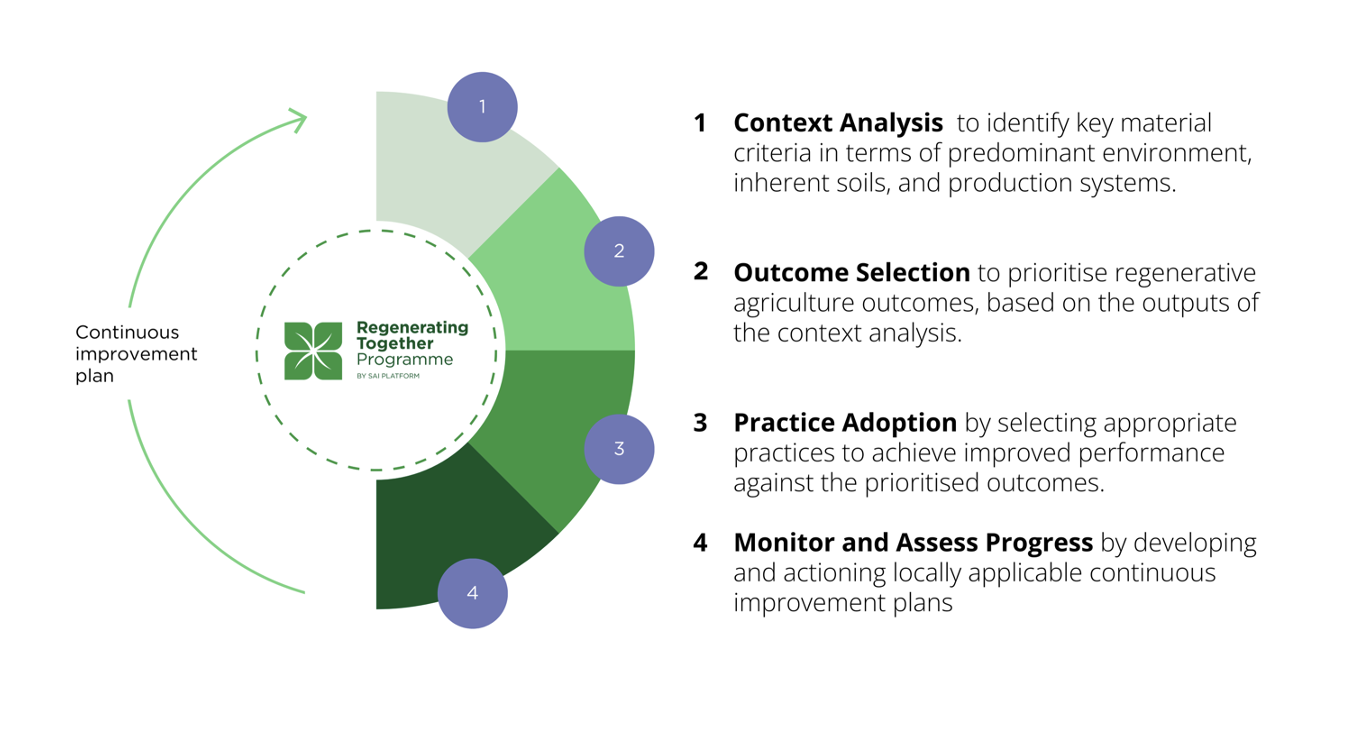
In support of a more consistent and coordinated approach to implementation across the sector, SAI Platform presented on its Regenerating Together Programme. The Programme provides a global framework for regenerative agriculture, enabling farmers across a diverse range of geographies and contexts to work with supply chain partners to achieve measurable regenerative agriculture outcomes. The framework is centred on a four-step process displayed in Figure 1.
Figure 1: The four-step process to implementing SAI Platform’s Regenerating Together Programme for regenerative agriculture
Several valuable insights were obtained from the presentation:
Strengthening long-term supply chain resilience is the primary driver of uptake by companies adopting regenerative agriculture. Consumer demand and regulation currently play a limited role.
There can be no one-size-fits-all approach to regenerative agriculture. Continuous improvement plans should be farmer-centric and underpinned by a context analysis to understand the specific environmental risks at farm level. This helps farmers to prioritise the environmental outcomes most relevant to their specific context and choose an appropriate combination of principles and practices to achieve these.
Trade-offs are highly context specific. For example, different climatic conditions shape the feasibility of certain practices, such as cover cropping and integrated grazing management. Furthermore, the dialogues with companies have highlighted the challenges of understanding and systematically measuring the trade-offs associated with regenerative agriculture, including short-term costs and potential productivity impacts. These difficulties are partly driven by limited consistency across the sector in how regenerative agriculture is defined and measured. As Brunel enters its third round of engagement meetings, we will look to explore these challenges in greater depth.
Farmers, retailers and supermarkets must be part of the discussion on regenerative agriculture, as key value chain actors.
Building a knowledge centre for regenerative agriculture to share best practices and opportunities in the sector. Data on the outcomes of regenerative agriculture is currently limited. The SAI Platform supports evidence-sharing through webinars, case studies, and partnerships, working to expand the resource base.
Call to action
We encourage investors to take a systemic view of regenerative agriculture – connecting the dots across climate, nature and supply chain resilience – and to collaborate with peers, companies and industry frameworks to drive coherent, scalable action.
—
For more information on our work on stewardship, the food sector and regenerative agriculture, contact Gemma James: gemma@chronossustainability.com
