
Nature-Related Investment Opportunities: Investor Briefing
Dr Rebecca Drury, Gemma James, and Dr Rory Sullivan
Chronos Sustainability was commissioned by the Principles for Responsible Investment (PRI) to map out the landscape of nature investment opportunities available to institutional investors. Four insights emerge from this work.
1. Nature is a material financial issue and a source of opportunity
Over half of global gross domestic product (GDP) is moderately to highly dependent on nature, yet trillions of dollars are still invested annually in activities that degrade it. It is estimated that the investment required to meet climate, biodiversity and land restoration targets by 2030 is US$571bn per year. While current financial flows fall well short of this amount, the growth in the amount of private sector finance for nature – rising elevenfold from US$9.4bn in 2020 to over US$102bn in 2024 – signals increasing investor recognition of nature as a material financial issue and a source of opportunity.
2. Nature-related financial instruments are at an early stage, but are evolving rapidly
Growing recognition of the material risks of nature loss is driving expansion and innovation in nature-related financial instruments. A range of investable opportunities is emerging from well-established real assets (like farmland and forestry), as well as through impact funds, thematic, outcome-based and sustainability-linked bonds to more nascent instruments like biodiversity credits and natural asset companies (NACs). Despite the range of opportunities, nature-related finance remains modest. Sustainable bonds account for only about 3% of the global bond market (with nature-related issuance only a subset of this, but there is no reliable data to estimate it) and biodiversity‑focused equity funds (approx. US$3.7bn) are dwarfed by other thematic strategies (climate-focused funds alone total US$640bn).
3. New regulations, market standards and guidance are emerging, but gaps remain
Governments are developing Global Biodiversity Framework-aligned policies that strengthen the standardisation and credibility of nature-related financial instruments. Examples include the EU Nature Restoration Law and the UK’s Biodiversity Net Gain (BNG), which have created regulated biodiversity credit markets. However, regulatory frameworks remain uneven and further action is needed to expand such markets and build investor confidence.
Market standards and guidance are enabling investment opportunities. The International Capital Market Association’s (ICMA) Principles now explicitly guide the development, monitoring and verification of nature-themed bonds, while the EU Green Bond Standard raises comparability through taxonomy alignment and European Markets and Securities Authority (ESMA)-supervised reviews. Yet other nature-related instruments still lack consistent regulation, valuation methodologies, and robust approaches for measuring and verifying nature outcomes.
4. Pathways exist to expand credible, scalable and investable nature markets
Though nature-related financial instruments exist, investors’ ability to scale is limited by market maturity: many opportunities are still early‑stage, pipelines remain thin and data, regulations and governance systems are still developing.
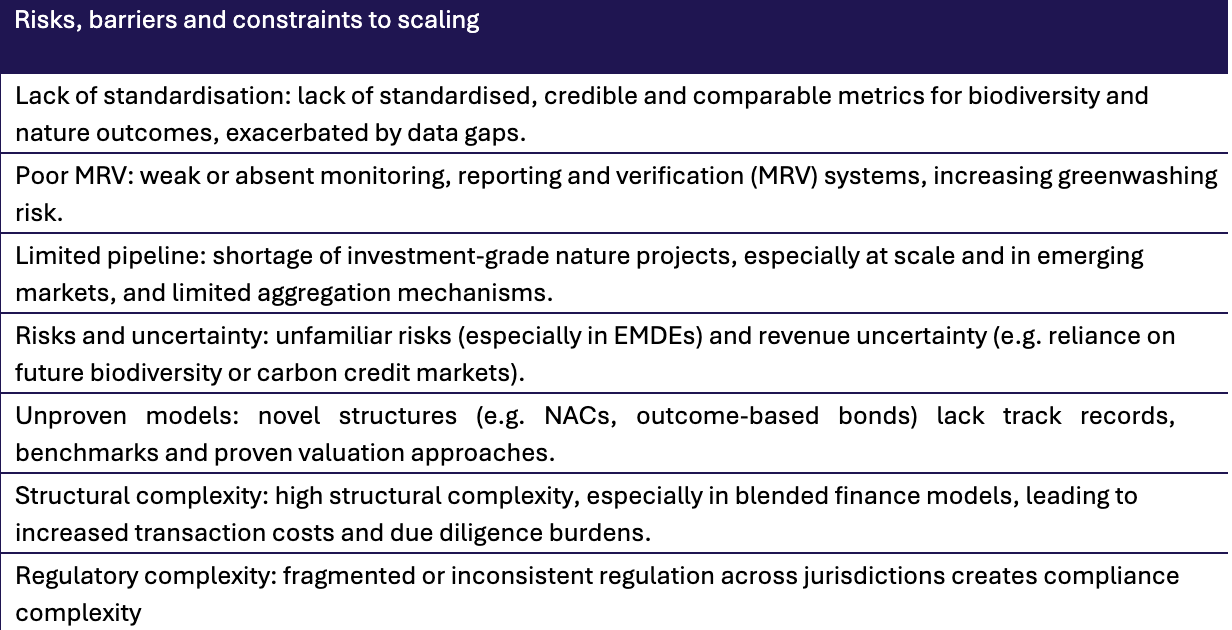
Our research suggests that many of the barriers to further investment are structural and transitional, rather than fundamental, and can be addressed through standardisation, policy alignment, novel mechanisms for blended finance, and more robust monitoring, reporting and verification (MRV). Some of the key barriers are presented in the Table. .
The Role of Investors
Our research also suggests that, by investing in nature-related opportunities, investors can strengthen portfolio resilience, capture long-term growth, and help shape markets that align with global biodiversity goals. Institutional investors can support nature-related investment opportunities by:
Identifying and allocating capital to high-integrity nature-related opportunities through implementing investment strategies that focus on companies that are significantly reducing nature-related dependencies and nature impacts of a business; or developing new business models, products and services that contribute to nature-positive outcomes.
Supporting the development and deployment of de-risking and deal structuring mechanisms to help scale the pipeline of opportunities: for example, blended finance structures, aggregation vehicles and credit enhancement tools, including by working in partnership with development finance institutions, development banks and governments.
Providing early-stage development capital and technical assistance to project developers or platforms that support project governance and delivery, to help scale the opportunity pipeline.
Advocating for mandatory TNFD-aligned corporate disclosure of management of nature-related risks and opportunities to help improve standardisation and data availability.
Advocating for regulatory conditions to scale high-integrity nature markets: including standardisation of metrics and nature valuation approaches, and clear guidance for MRV of nature outcomes that can improve market confidence.
—
Read more about our nature-themed services here or get in touch with our Nature & Biodiversity team via: gemma@chronossustainability.com
The report, Nature-related Investment Opportunities: Investor Briefing, commissioned by the PRI and prepared by Chronos Sustainability, can be accessed at: https://www.unpri.org/deep-dive?id=nature-related-opportunities-investor-briefing
