
Navigating Ocean-related Investment Risks and Opportunities
Tanya Cox, Cora Buentjen, Gemma James and Dr Rory Sullivan
Chronos worked with the First Sentier MUFG Sustainable Investment Institute to develop The Ocean Framework: An Investor Guide to navigating ocean risks and opportunities. The Framework provides investors with practical guidance on how to identify and assess ocean-related risks and opportunities, how to prioritise the most exposed sectors, companies and geographies, and where to access key data tools and evaluation resources.
The ocean covers 71% of our planet. It underpins the global economy in many critical ways. For example, it absorbs 90% of excess heat and 30% of atmospheric carbon, supports over 80% of the world's biodiversity, and enables 90% of global trade through maritime transportation. From an economic perspective, many major sectors — fisheries, aquaculture, tourism, and offshore renewables to name but a few — have a direct or indirect dependency on a healthy ocean. At the same time, industrial and destructive fishing, dredging, carbon emissions, habitat conversion and marine pollution degrade those very systems. Today, these drivers of ocean degradation coupled with the negative effects of climate change and ineffective governance are impacting the functioning of oceanic systems and disrupting the natural equilibrium between the ocean, land and atmosphere.
A framework to assess the risks and dependencies
For companies operating in or near the ocean (and the investors in these companies), this business-as-usual scenario presents significant risks to businesses as the resources that they depend on become scarce or threatened.
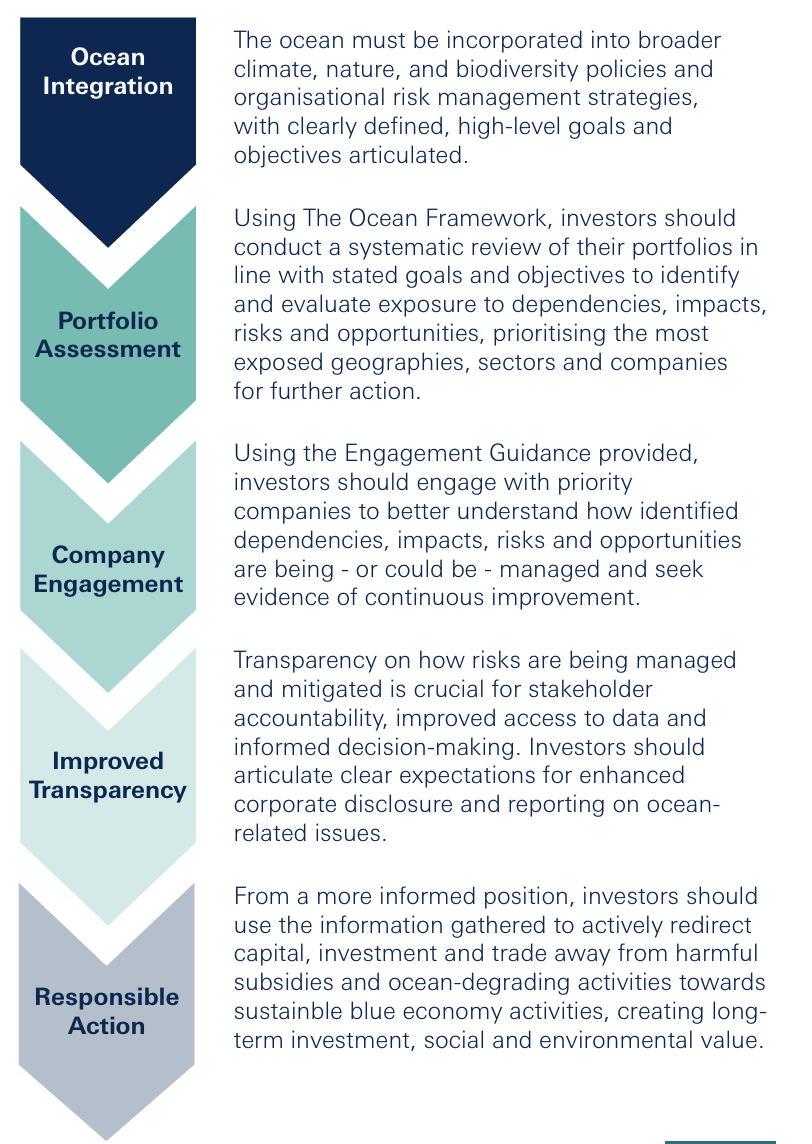
The Ocean Framework is designed as a practical and accessible decision-making framework for investors wanting to identify, assess and manage ocean-related risks and dependencies across sectors and investment portfolios. It is supplemented by guidance to support investor engagement with companies, offering a set of initial and follow up questions to put to companies to find out how they are identifying, assessing and managing ocean-related risks and opportunities. The Figure illustrates how the Ocean Framework can support, enable and inform investor decision-making.
Make it stand out
Whatever it is, the way you tell your story online can make all the difference.
Our View: Moving Beyond Conventional Risk Assessment
We – as society, as investors, as stakeholders – need to build a deeper understanding of the inherent value of the ocean and the potential that a sustainable blue economy has for future generations and financial returns. This is an important first step towards redirecting capital away from unsustainable practices in the traditional blue economy and aligning investments with sustainable economic activities that:
1. Preserve ocean ecosystem integrity by respecting conservation objectives and engaging with all stakeholders, including governments, coastal communities and Indigenous Peoples, and public and private institutions;
2. Adopt a precautionary approach to maximise social and economic benefits, such as food security, equity, and poverty eradication for present and future generations;
3. Ensureeconomic activities restore and increase resilience ofoceanic ecosystems and conserve biodiversity to support sustained productivity;
4. Operate within safe planetary boundaries to mitigate the impacts of climate change, reduce pollution, and prevent biodiversity loss.
Ultimately it is the extent to which we deliver on these goals that will determine whether we deliver on our obligations as stewards of the ocean environment.
--
Notes
1. The Ocean Framework report can be downloaded from: https://www.firstsentier-mufg-sustainability.com/content/dam/sustainabilityinstitute/assets/research/sii-ocean-framework-report.pdf
2. The report executive summary and supplementary guidance can be accessed at: https://www.firstsentier-mufg-sustainability.com/research/ocean-sustainability-is-a-foundational-pillar-of-global-environmental-social-and-economic-stability.html
3. The First Sentier MUFG Sustainable Investment Institute (the Institute) is jointly supported by First Sentier Group (FSG) and Mitsubishi UFJ Trust and Banking Corporation. The Institute provides research on Environmental, Societal and Governance (ESG) issues, recognising that if investors better understand these factors, they will be better placed to consider their investment decisions and use their influence to drive positive change for the benefit of the environment and society. For more information, see https://www.firstsentier-mufg-sustainability.com/
Image credit: Humberto Braojoes, Unsplash.
--
To talk to Chronos about our work on ocean sustainability contact: Tanya Cox.
